

By Isa Jane D. Acabal, Researcher
THE PHILIPPINE ECONOMY likely expanded at a slower pace in the fourth quarter of 2025, bringing full-year growth below the government’s target amid a corruption scandal, analysts said.
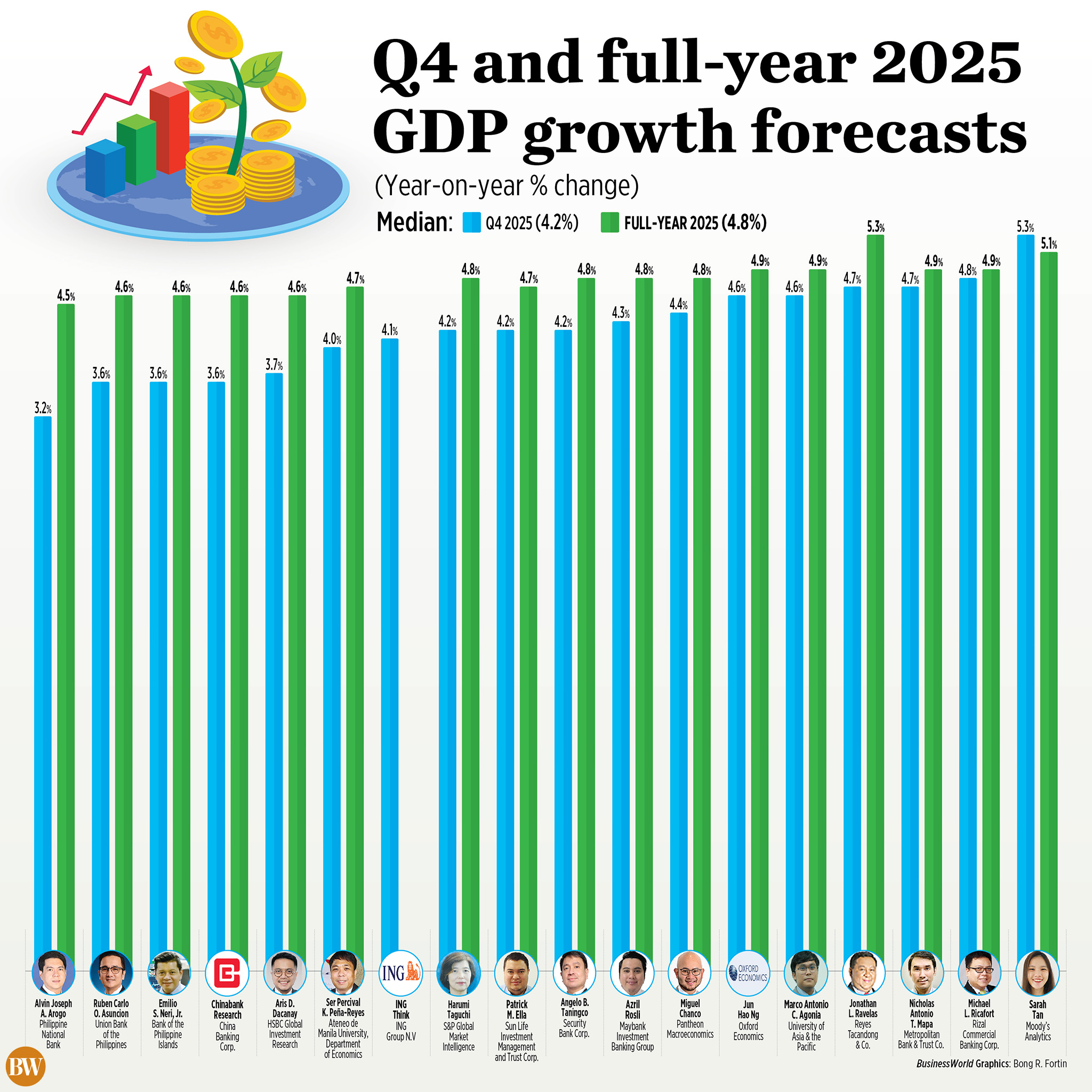
Gross domestic product (GDP) may have grown by an annual 4.2% from October to December, according to a median forecast of 18 economists polled by BusinessWorld.
If realized, the growth is much slower than the 5.3% expansion in the same period in 2024. Quarter on quarter, GDP growth picked up from the over four-year low of 4% in the third quarter.
This would put the full-year 2025 median estimate growth at 4.8%, missing the Development Budget Coordination Committee’s 5.5%-6.5% growth target.
If realized, this would be slower than the 5.7% expansion in 2024 and the weakest since the 9.5% contraction posted in 2020.
The full-year GDP estimate is also below the forecasts of the Asian Development Bank (5%), World Bank (5.1%), International Monetary Fund (5.1%), and the ASEAN+3 Macroeconomic Office (5.2%).
The Philippine Statistics Authority (PSA) will release the fourth-quarter and full-year 2025 GDP data on Thursday, Jan. 29.
Harumi Taguchi, principal economist at S&P Global Market Intelligence, said weak government spending is the main factor that constrained growth in the fourth quarter and full year.
“We anticipate weak government spending and public fixed investment, reflecting the impact of ongoing corruption issues,” she said in an e-mail.
A wide-scale controversy linking Public Works officials, lawmakers and private contractors to multibillion-peso corruption in anomalous flood control projects dragged government spending and household consumption. The Independent Commission for Infrastructure (ICI) has been investigating these allegations.
Government spending fell for a fourth straight month in November to P498.31 billion, down by 9.6% year on year.
“On government spending, we’ll probably see more of the actual short-term damage caused indirectly by the ICI’s formation and investigations, which only really kicked off at the end of Q3. (Fourth quarter), therefore, should feel the brunt of this natural lull and hesitancy on the part of both public and private developers,” Miguel Chanco, chief emerging Asia economist at Pantheon Macroeconomics, said.
Ruben Carlo O. Asuncion, chief economist at the Union Bank of the Philippines, said the slower annual GDP growth reflected the impact of the corruption scandal.
“The weakness reflects the broad fallout from the flood control corruption probe, which dampened public construction, delayed fiscal disbursements, and weighed heavily on consumer and business sentiment through the end of the year,” he said. “High‑frequency indicators also showed sluggish household spending and soft labor‑market conditions as unemployment ticked up and job creation stalled.”
Patrick M. Ella, an economist at Sun Life Investment Management and Trust Corp., said the decline in consumer and investor confidence following the graft scandal “has translated to slow consumption and a contraction in private investments.”
“The decline in government spending following heightened disbursement scrutiny hit the economy hard in the year. The impact of government spending multipliers declined, reducing aggregate demand and hurting economic growth,” Marco Antonio C. Agonia, an economist at the University of Asia and the Pacific (UA&P), said.
Aside from weak government spending, natural disasters hampered infrastructure development and economic activity, according to Angelo B. Taningco, chief economist at Security Bank Corp.
In 2025, a total of 23 tropical cyclones entered the Philippine Area of Responsibility, as recorded by the state weather bureau.
Ms. Taguchi said natural disasters have also negatively affected agricultural production, disrupted supply chains and weighed on production, tourism, and retail sales.
“Private consumption and private investment are projected to see moderate growth, tempered by adverse weather conditions in the fourth quarter of 2025,” she added.
RATE CUTSMaybank Investment Bank economist Azril Rosli said GDP growth was mainly due to “resilient” private consumption backed by easing inflation, rate cuts by the Bangko Sentral ng Pilipinas (BSP), and the “modest” recovery in net exports.
Inflation quickened to 1.8% in December from 1.5% in November, bringing average inflation for full-year 2025 at 1.7% — the slowest pace in nine years.
“The slowdown in inflation over the past few months was a result of favorable base effects and the sustained decline in rice and energy prices throughout the period,” Nicholas Antonio T. Mapa, chief economist at the Metropolitan Bank & Trust Co., said in an e-mail.
“The quick step to a more accommodative monetary stance likely helped jumpstart flagging investment momentum,” he added.
The BSP has reduced key borrowing costs by a total of 125 basis points in 2025, bringing the key policy rate to an over three-year low of 4.5%.
“The BSP’s interest rate cuts thus far have yet to have a meaningful impact on economic growth, and it shows how weak 2025 was overall. The transmission of rate cuts to stronger activity in the real economy is naturally quite long for emerging markets such as the Philippines, one thing that the BSP is well aware of,” Pantheon Macroeconomics’ Mr. Chanco said.
UA&P’s Mr. Agonia said rate cuts’ impact on the real economy is minimal in the short term as monetary policy actions have a one-and-a-half to two-year lag.
“Rate cuts done in 2025 will likely provide palpable boosts to economic performance only by the second half of 2026 and into 2027,” he added.
At the same time, stronger exports and a narrower trade deficit likely drove GDP growth amid “robust external demand for semiconductors and ongoing diversification efforts amid protectionist policies in the [United States],” Chinabank Research said.
Preliminary data from the PSA showed the country’s balance of trade in goods — the difference between exports and imports — narrowed to $3.51 billion year on year in November from a $4.19-billion deficit in October.
Exports rose by 21.3% to $6.91 billion in November, faster than the 20.3% growth registered in October. This was mainly driven by the 50.6% increase in electronic products to $4.19 billion.
“Moderate global growth limited our projected export growth in 2025, although the impact of US tariff increases has been milder than anticipated,” S&P Global’s Ms. Taguchi said.
RECOVERY IN 2026?This year, economists anticipate a gradual recovery in GDP growth as the government implements catch-up spending.
“To lift growth in 2026, policy focus should shift toward stronger fiscal execution, accelerated infrastructure and energy investments, enhanced disaster resilience, and deeper structural reforms to crowd in private investment and improve export competitiveness,” Maybank’s Mr. Rosli said.
“Monetary easing alone is unlikely to deliver a meaningful growth acceleration without these complementary measures,” he added.
Rizal Commercial Banking Corp. Chief Economist Michael Ricafort said the government’s catch-up spending plans and other anti-corruption efforts are expected to boost growth in the first quarter.
“If anti-corruption measures and other related priority reforms that further level up governance standards would be taken seriously, these would be the missing and remaining important catalyst that would help improve investor confidence,” Mr. Ricafort said.
Jonathan L. Ravelas, a senior adviser at Reyes Tacandong & Co., said the economic growth can pick up to 5.6% in 2026 “if the government focuses on clean and timely spending, stronger infrastructure delivery, more predictable policy signals, and real support for agriculture and small businesses.”
Bank of the Philippine Islands (BPI) Lead Economist Emilio S. Neri, Jr. said the economy might see better numbers in the second half of 2026 if there are fewer natural disasters.
“It was disappointing, of course, as our potential growth is closer to 6% to 8%. Improving the quality of public spending by banning all forms of conflict-of-interest is what’s needed to get the economy back to its full potential,” Mr. Neri said.
Economic managers expect GDP to grow by 5-6% this year.