

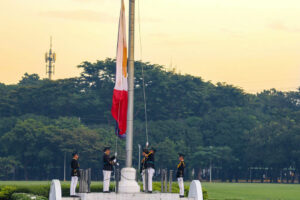
As someone who has worn the uniform of the Armed Forces of the Philippines (AFP) for decades, I have come to understand that loyalty is not just a word we recite in our oaths — it is a discipline, a way of life, and the bedrock of our profession. Today, in the midst of political turbulence and widespread frustration over corruption scandals, such as the flood control project scams, I find great importance in General Romeo Brawner’s firm statement that the AFP will remain true to its mandate and uphold the Constitution above all else.
This assurance is not mere rhetoric. It is a reminder of what the AFP has always stood for: service without partisanship, sacrifice without expectation of reward, and fidelity to the nation’s highest law, even when political storms threaten to shake its foundations.
WITNESSING THE DAMAGE OF CORRUPTIONDuring my years in uniform, I witnessed how corruption at the highest levels of governance drained not only resources but also the people’s trust. The recent scandals involving flood control projects are particularly painful to see. These projects are meant to protect Filipino families from the recurring devastation of floods — yet, once again, greed has found its way into what should have been a shield for the most vulnerable.
I was a witness to EDSA I and a participant in EDSA II, while still in active service. History is a testament that military intervention in both cases failed to arrest or even mitigate corruption. In fact, intervention was partially tainted with the political ambitions of some senior officers. Since then, corruption has slowly crept into our political system, like cancer cells that have metastasized. Radical change is needed — not from the military, but from the nation’s highest leadership. Initial actions may offer modest relief, but they remain far from encouraging.
What the country needs are more leaders in the mold of Vince Dizon, Benjie Magalong, and Ping Lacson. Above all, it is time for the Presidency to exercise decisive leadership by declaring the existence of a national emergency under Republic Act No. 6826, for a limited period and subject to strict restrictions. It must be done now — not tomorrow or in some distant future. Every day counts, and each day will define whether our country transitions into a failed state or begins to recover its strength.
For the ordinary Filipino already burdened by inflation, job insecurity, and natural disasters, this betrayal is disheartening. It is in times like this that the AFP’s voice matters most. General Brawner’s words reaffirm that while political leaders may falter, the military remains steadfast in its duty to the people and the Constitution.
THE MANDATE I SWORE TO DEFENDWhen I entered the service, I pledged my loyalty not to any politician, but to the Republic. That same oath binds every soldier today. The AFP’s mandate is not limited to defending our borders or defeating armed threats. Equally vital is the duty to ensure that the military is never used as a political weapon or dragged into partisan disputes.
History, both here and abroad, shows us the dangers when the military abandons professionalism for politics. Coups, dictatorships, and broken democracies have all been born out of such failures. That is why General Brawner’s declaration is critical: it draws a clear line that the AFP’s loyalty is to the Constitution and the people — not to personalities or factions.
This professional distance from politics is what preserves democracy. When leaders stumble, the AFP must rise above the noise and remain a stabilizing force. That is how the AFP maintains its credibility and continues to earn the trust of the people.
STABILITY IN A DIVIDED NATIONThe Philippines has endured cycles of political unrest and corruption. In these times, the AFP has always been looked upon as a stabilizing force — not perfect, but consistent in its service. Having been part of that long tradition, I know how heavy the responsibility is.
General Brawner’s reassurance should remind the public that politicians may come and go, but the AFP’s commitment to the Constitution remains constant. This is not rooted in ambition, but in discipline, sacrifice, and love of country. In a climate where anger and frustration over corruption run deep, the AFP’s neutrality and professionalism offer a much-needed anchor for the nation.
A CHALLENGE TO OTHER INSTITUTIONSWhile I take pride in the AFP’s resolve, I must emphasize that fighting corruption cannot be the military’s battle alone. Other branches of government — Congress, the Judiciary, local governments — must rise to the same standard of integrity. If the AFP can uphold professionalism in the face of pressure, surely civilian leaders can do no less.
The challenge, then, is for every institution to look in the mirror. The military can shield the nation from external threats and preserve stability, but it cannot heal the wounds caused by systemic corruption. That task requires leaders of character and citizens who demand accountability.
CONCLUSION: THE OATH THAT NEVER EXPIRESThough I am now retired, my oath to the Constitution and to the Filipino people did not end with my service. It remains a moral compass that guides how I see the challenges facing our country today.
General Brawner’s statement resonates with me deeply because it affirms what I know to be true: that the AFP will never abandon its duty to the Republic. In the face of political turmoil and corruption, this commitment shines as a beacon of hope.
The AFP’s example should not only be praised but followed. For if soldiers can uphold integrity and professionalism despite immense trials, then civilian leaders must do the same.
The Philippines deserves leaders and institutions that serve with honor — not for self, but for the country.
Gen. Jaime “Jimmy” S. De Los Santos is a member of the Management Association of the Philippines National Issues Committee. He was the 42nd commanding general of the Philippine Army.