

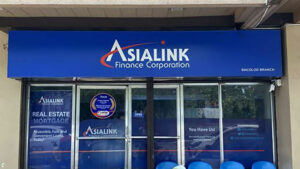
ASIALINK Finance Corp. (AFC) has received “BB” long-term and “B” short-term issuer ratings from S&P Global Ratings and a “Ba2” long-term corporate family rating (CFR) from Moody’s Ratings, with both debt watchers citing the company’s market leadership and strong capital position.
This is the first time that the two debt watchers assigned ratings for the nonbank financial institution. They both gave “stable” outlooks for their respective below investment-grade assessments, which means the ratings are unlikely to change in the near term.
“Our ratings on Asialink reflect our view that the company will maintain its leadership in Philippines’ refinancing and second-hand auto loan segments over the next 12-24 months,” S&P Global said in a statement. “The company has strong capitalization, boosted by a significant equity infusion from its financial sponsor — Creador, a private equity fund.”
In 2024, Creador invested P4 billion into Asialink to help fund its expansion plans.
“AFC’s ‘Ba2’ CFR reflects the company’s strong capitalization and profitability, underpinned by its extensive domestic franchise… AFC is one of the largest non-bank financial institutions in the Philippines, which supports micro, small and medium enterprises (MSMEs) by providing loans backed by collateral (vehicles and real estate), by revenue and number of physical branches. Its strong franchise is evidenced by its branch distribution across the country, extensive collection infrastructure and dealer partnerships, providing it with a competitive business advantage,” Moody’s Ratings said in a separate statement.
S&P Global said Asialink has a niche position in the second-hand car and truck financing market, cornering a 10-15% share.
“The market for financing used vehicles is highly fragmented with numerous small players… Asialink has a competitive advantage over its smaller peers due to its significant scale and branch network. These are important because auto financing in provincial areas requires an on-the-ground presence to be near the customer, to facilitate loans disbursement and collection,” it said.
Moody’s Ratings said the company’s strength lies in its capitalization as its tangible common equity to tangible managed assets (TCE/TMA) grew to 27.4% at the end of last year from 17.6% in 2023.
“Its high capital would provide sufficient buffers against the cyclicality of potential loan losses. We expect its TCE/TMA will remain above 21% in the next two years.”
“We forecast the company will have a risk-adjusted capital ratio of about 19% over the next two years, compared with about 20.4% as of Dec. 31, 2024… Asialink’s modest targeted dividend payout ratios of 20%-30% for 2025-2027 will also support its strong capital position,” S&P Global added.
It projects 25%-28% annual loan growth for this year until 2027, slightly slower than the 2021-2024 compounded annual growth rate of 34%.
S&P Global said “very high margins” on Asialink’s core lending book also support its profitability, with its average loan size, mainly for individuals and small and medium enterprises, at about $8,500 and having effective lending rates of 23%-30% per annum.
“The company’s return on average assets (ROAA) of 5.5% for 2024 compares favorably with the Philippines banking sector average of 1.5%, and the 2.5%-3.0% peer average for finance companies in Southeast Asia… We forecast Asialink’s ROAA will recover to about 6.5% in 2027. The projected profit levels are lower than a recent peak of 7.5% in 2022, reflecting the company’s shift toward secured lending, where yields are lower than for unsecured personal loans. Pre-pandemic, Asialink’s loan portfolio had 30% secured loans and 70% unsecured consumer loans. Today, the portfolio is 95% secured.”
Elevated credit costs seen in 2024 may continue to affect Asialink’s 2025 profit but could ease over the next two years, it added.
“Our base case assumes Asialink’s net interest margin (NIM) will improve to 24%-26% over 2025-2027, compared with 23%-24% in 2022-2024. The company’s loans predominantly have a fixed rate, while its funding costs for bank loans correlate with policy rates. Policy rates in the Philippines peaked at 6.5% in 2024, and have since been cut to 4.75%. We forecast the rates will decline to 4% by 2027, which will support NIM improvement,” S&P Global said.
“Given that its lending rates show low sensitivity to the central bank’s interest rate cuts, AFC’s NIM will benefit from lower funding costs over the next 12-18 months,” Moody’s Ratings added.
ASSET QUALITYMeanwhile, both credit raters noted that the company faces some asset quality risks due to rapid loan growth and its focus on higher-risk borrower segments like individuals and small business owners
“Management’s steps to tighten underwriting standards, and the company’s strong capitalization and good profitability temper these risks,” S&P Global said. “Asialink’s heavy emphasis on loan collection and collateral recovery helps to control credit risks. The company leverages its extensive physical presence and network of collection agents to collect past-due loans and foreclose the underlying collateral.”
“AFC’s asset quality, while modest, benefits from an effective collateral collection process with borrowers and strong recovery rates. While AFC has a high default rate on its portfolio, in the low double-digit range, the loss given default is substantially reduced by collateral sales. We expect AFC’s asset quality to remain largely stable, with risks arising from its high loan growth and high level of defaults, balanced by its strong ability to collect and sell collateral,” Moody’s Ratings said.
Both debt watchers also flagged concentration risks in Asialink’s funding profile.
“Unlike its regional peers, AFC’s funding sources are not as diversified due to limited access to capital markets, and it has funding concentration to a single domestic bank. Regardless, the company has good access to credit lines, including access to long term funding from global development financial institutions (International Finance Corp. and Asian Development Bank), and its maintenance of P1-1.5 billion minimum cash buffer, helps to mitigate its refinancing risks,” Moody’s Ratings said.
“In our opinion, Asialink’s main funding providers are unlikely to cut or reduce credit lines. However, they could be circumspect in increasing their exposure due to single-borrower limits or concentration considerations. Asialink is seeking new funding lines from local banks, foreign banks, and multilateral agencies to diversify funding and ease concentration risks. It has had early success on this front,” S&P Global added.
It said its “stable” rating outlook shows that it expects the company to keep its market leadership and strong capitalization despite intense competition in the used vehicle financing segment.
S&P Global and Moody’s Ratings both said they could upgrade their ratings if Asialink shows improvements in its funding profile and asset quality, while significant deterioration of both could lead to a downgrade.
Moody’s Ratings added that the strength or weakness of the operating environment for Philippine financing companies could also affect its assessment of the company. — K.K. Chan