The Supreme Court (SC) has ruled that the PhilHealth fund transfer of P60 billion back to the National Treasury in 2024 was unconstitutional and hence, void. The SC then ordered the Treasury to return to PhilHealth the P60 billion. Here are the 10 myths that surrounded the fund transfer.
First, it was former Finance Secretary Ralph G. Recto who orchestrated the fund transfer. Wrong. It was Congress via Special Provision 1(d), Chapter XLIII of the General Appropriations Act (GAA) 2024. In the process, Congress tried to amend existing laws via rider provisions in the GAA.
Second, the Department of Finance (DoF) order was arbitrary. Wrong. DoF Circular No. 003-2024, which implemented the fund transfer, has a legal basis through GAA 2024, and it was backed by five agencies — the Office of the Solicitor General, Office of the Government Corporate Counsel, Governance Commission for Government-Owned and -Controlled Corporations, Commission on Audit and the PhilHealth Board itself. The target amount was P89.9 billion of idle PhilHealth funds; the P60 billion has been returned to the Treasury while the P29.9 billion was kept by PhilHealth.
Third, former Congressman Joey Salceda made the insertion to sweep some excess funds of GOCCs for unprogrammed appropriation projects. Wrong. This claim was made by former SC Justice Tony Carpio, and Mr. Salceda made a letter denying he did it because he was not a member of the House appropriations committee, the small committee or the bicameral conference committee during the 19th Congress.
Fourth, the P60 billion was used to finance the pork barrels of legislators. Wrong. The amount funded the following: P27.5 billion for the public health emergency benefits and allowances for health and nonhealth workers during the coronavirus lockdown; P10 billion for medical assistance to indigent and financially incapacitated patients; P4.1 billion for the procurement of various medical equipment for DoH and LGU hospitals; P3.4 billion for the construction of three DoH health facilities; and P1.7 billion for the health facilities enhancement program. A total of P46.7 billion funded health-related spending. The other P13-billion funded government counterpart financing for foreign-assisted infrastructure and social development projects.
Fifth, the fund transfer worsened government finance. Wrong. By transferring the P60 billion in 2024, Mr. Recto avoided new borrowings and the additional rise in public debt stock by P60 billion, as well as interest payments of about P3.8 billion a year, derived as: P60 billion multiplied by 6.3% — the average interest rate in 2024.
Sixth, the P60 billion came from members’ contributions. Wrong. That money came from taxes paid by smokers, vapers, drinkers of alcohol and sugar beverage, from gamblers and bettors of PAGCOR and PCSO. Many health activists who are angry at tobacco and alcohol are hungry for the billions of pesos of taxes from tobacco and alcohol, and this shows double talk.
Seventh, the PhilHealth subsidy is eroded. Wrong. From a pre-lockdown subsidy of P67.7 billion in 2019, it rose to P100 billion in 2023, and will further rise to P113 billion in 2026 (P53 billion allocated plus P60 billion in returned funding).
Eighth, public finance is fine if unnecessary transfer of funds is avoided. Wrong. The spend-spend-spend mentality in our society, both by government and nongovernment groups, will cause a big fiscal problem in the coming years. The rising public debt and interest payments are of little concern to many people; their main concern is how many billions they can secure for their sectors — public works, health, education, social work, etc.
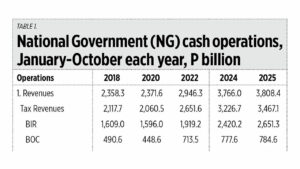
For the first 10 months of the year, our interest payments alone hit P295 billion in 2018 or an average of P1 billion a day, rising to P433 billion in 2022 or P1.4 billion a day, P2.1 billion a day in 2024 and P2.4 billion a day in 2025. This year, expenditures by the National Government (NG) are flat, and subsidies to GOCCs have declined, but transfers to LGUs and interest payments are rising, leading to a P1-trillion-plus budget deficit (see Table 1).
Ninth, expanding the return of funds to Philippine Deposit Insurance Corp. (PDIC) will help stabilize public finance. Wrong. The P107-billion PDIC funds transferred to the National Treasury actually helped the country save money from high interest payments. I made this estimate of savings from interest payments in 2024 and 2025, then an additional burden in 2026 and 2027, assuming a P27-billion amortization a year after.
Tenth, Secretary Recto is liable for all the mess in fund transfer. Wrong. As asserted by four SC Justices, Mr. Recto simply implemented the law, GAA 2024’s rider provision. Associate Justice Raul Villanueva in particular argued that to hold Mr. Recto liable in any way “is like punishing him for simply doing his job.”
As shown in my estimates above, Mr. Recto saved the country around P20 billion in interest payments last year and this year. The man did public service while people who go after him only do malice.
Bienvenido S. Oplas, Jr. is the president of Bienvenido S. Oplas, Jr. Research Consultancy Services, and Minimal Government Thinkers. He is an international fellow of the Tholos Foundation.