
The numbers no longer whisper. They shout.
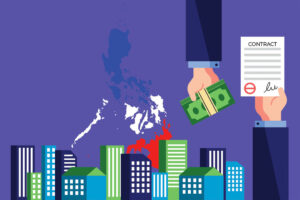
Last Wednesday’s broadsheets carried a grim headline: foreign direct investment (FDI) has slumped sharply, driven by a collapse of more than 50% in non-residents’ net investments in debt instruments such as intercompany loans and related financing. In normal circumstances, such a retreat could be blamed on global headwinds, tightening financial conditions, or deteriorating macroeconomic fundamentals. But this time, the explanation lies much closer to home, and it is deeply uncomfortable.
As we noted in our GlobalSource Partners commentary released the same day, the fall in FDI reflects “recent governance developments.” In plain terms, this is about corruption. The flood control scandal, together with long-standing concerns about weak public accountability and selective justice, has poisoned investor confidence. The October year-on-year plunge in FDI is not a statistical accident. It is a verdict.
The data reinforce what investors have been quietly signaling for months. Confidence in Philippine governance is eroding, and patience is running out.
This is not an isolated episode.
Even before the October collapse, FDI inflows had already weakened in August and September. That pattern points to a sustained deterioration in sentiment, not a temporary market overreaction. Modest gains in equity investments and reinvested earnings were simply not enough to offset the chilling effect of policy uncertainty, institutional fragility, and governance risks. Momentum now works against the country and once credibility is lost, it is extraordinarily difficult to recover.
To be clear, the Philippines is not devoid of talent or institutional foundations. There are competent and principled public servants. There are laws on the books, agencies with mandates, and policy frameworks that could function if insulated from politics and rent-seeking, particularly on the fiscal side. But these strengths are being overwhelmed by a far more powerful signal that accountability is optional for the powerful, and justice is negotiable.
Investors are not confused. They are responding rationally.
Weak governance is now intersecting with weak investment fundamentals. Despite a larger economy and a growing population, gross capital formation remains stubbornly low, reaching only about 23% of GDP. This places the Philippines at the bottom tier of investment performance in the region. Thailand, Malaysia, and Singapore occupy similar ranges today, but they posted much higher investment shares when they were growing at high single-digit rates. Meanwhile, Indonesia, Vietnam, and Cambodia consistently invest between the mid-20s and over 30% of GDP.
This gap matters.
Countries that invest more build faster, learn quicker, and compete better. Vietnam has already overtaken us. Cambodia, with investment ratios above 30%, is not far behind. An economy that fails to invest condemns itself to slower growth, weaker productivity, and declining relevance.
And yet, just as the country struggles with low physical investment, it faces an even more daunting challenge. This is preparing the people for an economy being reshaped by artificial intelligence (AI) and innovation.
IMF Managing Director Kristalina Georgieva has been unequivocal in saying that countries that fail to prepare workers and firms for the AI transition will fall behind, quickly and decisively. For the Philippines, this means equipping young people with cognitive, creative, and technical skills that complement AI rather than compete with it. It means reskilling displaced workers before they are pushed into permanent redundancy.
But the starting point is deeply troubling. Philippine students continue to perform poorly in reading, science, and mathematics. Creative thinking scores are alarmingly low. These are not abstract indicators — they are early warnings of a workforce ill-prepared for the demands of a high-productivity, innovation-driven modern economy.
The IMF’s new Skills Imbalance Index makes the global stakes even clearer. Countries that successfully align skills with future demand will enjoy labor mobility, adaptability, and growth. Those that fail will face stagnation, inequality, and social strain. This reality demands not only education reform but also stronger competition policy, easier entry for new firms, and robust social protection systems to support job transitions.
And this is precisely where corruption inflicts its deepest damage.
Every peso lost to graft is a peso stolen from classrooms, laboratories, digital infrastructure, and public health. With national budgets leaking and public trust evaporating, hopes for a decisive pivot toward human capital development remain just that. Hopes. Public discourse is still trapped in the language of minimum adequacy, while the future demands excellence.
Yes, the 2026 national budget emphasizes human capital, digital transformation, and infrastructure. Funding for science and technology, digital connectivity, education, and innovation has increased. These are welcome steps. But incremental progress will never be enough if systemic corruption continues to undermine execution. A bigger budget means little if governance remains broken.
Investors see the contradiction clearly. They value Filipinos’ English proficiency, work ethic, and adaptability. At the same time, they flag weak digital skills, narrow technical competencies, and low productivity. Domestic firms echo these concerns, pointing to persistent skills mismatches and the urgent need for education reform and more flexible labor policies. Unless these structural issues are addressed decisively, capital flows will remain volatile and increasingly scarce.
Some will argue that the Philippines is improving its competitiveness. The data supports modest progress. Rankings in global competitiveness and digital readiness have inched upward. But this is faint praise. Improvement from a low base does not change the fact that we remain well behind our ASEAN peers — and are falling further behind those moving decisively.
More damaging still, whatever gains we achieve are being wiped out by the perception, and reality, of bad governance. Transparency International’s 2024 Corruption Perceptions Index ranked the Philippines 114th out of 180 countries, with a score of 33. This places us far below the global and regional averages, and behind every major ASEAN competitor. Singapore, Malaysia, Vietnam, Indonesia, and Thailand all outperform us, for some, dramatically.
These rankings reflect what investors already believe: that transparency is weak, enforcement selective, and accountability uncertain. With the flood control scandal dominating headlines, there is every reason to expect further reputational damage.
It should be no puzzle, then, that October’s FDI inflows collapsed. One headline said it plainly: “Corruption puts investors on edge.” The country’s largest business group warned that investment sentiment will continue to deteriorate unless those implicated in the multibillion-peso scandal are held accountable even at the highest levels. The Philippine Chamber of Commerce and Industry was right to say that foreign investors’ patience is “razor-thin.”
This warning must not be ignored. While global shocks matter, corruption has become a decisive factor in the country’s investment decline. Calls to strengthen safeguards in the 2026 budget are necessary — but they are no substitute for credible enforcement and visible accountability.
The fiscal consequences are already severe. National Government debt has more than doubled in six years, rising from P7.7 trillion before the pandemic to an estimated P17.6 trillion, or over 63% of GDP. Debt servicing now absorbs roughly P2 trillion a year — resources that should have gone to infrastructure, education, and innovation. With revenues persistently low and expenditures high, borrowing pressures remain relentless.
Under these conditions, sustained growth is not just unlikely, it is implausible.
So if we ask why the economy refuses to lift off, we might recall James Carville’s blunt advice: “It’s the economy, stupid.” But in the Philippines today, the diagnosis is sharper and more uncomfortable.
It’s the corruption, sir.
Diwa C. Guinigundo is the former deputy governor for the Monetary and Economics Sector, the Bangko Sentral ng Pilipinas (BSP). He served the BSP for 41 years. In 2001-2003, he was alternate executive director at the International Monetary Fund in Washington, DC. He is the senior pastor of the Fullness of Christ International Ministries in Mandaluyong.