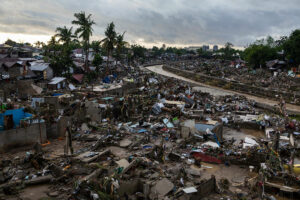
Cebu. — REUTERS/ELOISA LOPEZ
By Kenneth Christiane L. Basilio, Reporter
A LAWMAKER urged tighter scrutiny of government spending amid the year-long state of national calamity, pushing for greater congressional oversight on disbursements on agencies prone to corruption.
Having tighter supervision and greater public participation in bidding processes would help ensure contracts are awarded properly to curb wasteful spending and fund malversation, Party-list Rep. Terry L. Ridon, who heads the House Public Accounts Committee, said on Wednesday.
President Ferdinand R. Marcos, Jr. placed the Philippines under a year-long state of national calamity after two successive typhoons in November left hundreds dead and caused billions in damage. This declaration allows authorities to bypass regular bidding and directly negotiate with suppliers.
“We need to be vigilant about it,” he told BusinessWorld in an interview. “That’s really our safeguard against agencies and officers who will try to take shortcuts and engage in corrupt practices.”
His statement comes as lawmakers ahead of a joint oversight committee Congress will convene to scrutinize public disbursements amid a widening multibillion peso corruption scandal that has implicated officials, politicians and private contractors.
“All agencies are susceptible to corruption,” said Mr. Ridon. “But of course, there are certain agencies that are notorious for this — basically infrastructure agencies with kickbacks, substandard projects, and ghost budgets.”
“That’s why they really need to be closely monitored,” he added.
He had said the House Public Accounts panel would examine bidding and project implementation in the Public Works, Health and Education departments to crack down on corruption, noting that infrastructure projects have traditionally been prone to kickbacks.
“It is important that the materials reflect the market prices,” Mr. Ridon said. “Also a big part of it lies in the actual implementation, which is why the committee is exercising its oversight functions to ensure it is carried out properly.”
He said that oversight would include going to the offices of the agencies under monitoring.
“This means looking at how meetings are conducted in the Public Works department at the district level, what those meetings look like at the central office, and how bidding is really carried out there,” he said.
Ederson DT. Tapia, a political science professor at the University of Makati, said opening state spending to public monitoring is a vital step toward improving accountability.
“Opening state spending to public monitoring sends a clear signal that accountability should not be confined to closed rooms or technical committees,” he said, but warned that the system should be “user-friendly” for the transparency thrust to be effective.
“Public access should not mean simply placing large volumes of raw data online. If information is difficult to locate, poorly organized, or highly technical, participation becomes superficial and limited to a few specialists,” said Mr. Tapia. “Public monitoring can strengthen accountability, but only if it is designed with the public in mind and not merely to satisfy disclosure requirements.”
Granting the public greater access to monitoring state spending could strengthen efforts to prevent corruption, Joy G. Aceron, convenor-director of transparency group G-Watch, said.
“It can be a deterrent, and it adds to the dynamism of governance with more diverse actors involved checking and balancing each other,” she said in a Facebook Messenger chat. “There are many ways the public can monitor governance, and one that has been proven effective in several studies is through multi-level civil society monitoring and advocacy.”
She said there needs to be a “shared leadership and balanced collaboration between government and civil society,” including state efforts to strengthen nongovernment organizations to bolster checks and balances.