
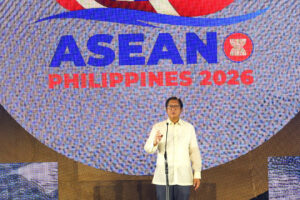
THE Philippines is still finalizing the list of foreign leaders outside the Association of Southeast Asian Nations (ASEAN) who are expected to attend the Manila summit this year, the government’s National Organizing Council (NOC) said on Thursday.
“As practice in ASEAN, the second summit we do receive leaders from non-ASEAN countries. So we’re talking about Japan, Korea, China, Australia, New Zealand, the US, India,” ASEAN Spokesperson Dominic Xavier M. Imperial told a press briefing.
“But as for the confirmation of who exactly, I think it’s too early to say,” he added.
The Philippines is set to hold more than 200 clustered meetings this year, as the country host the regional bloc’s annual summit, according to the NOC.
The meetings are expected to bring in foreign leaders and dignitaries from regional neighbors and non-ASEAN dialogue countries to discuss potential security, trade, and economic concerns.
“We’re working on bringing these leaders, especially the dialogue partners, for the second summit. I think along the way we will be able to get more confirmation,” Mr. Imperial said.
The 48th ASEAN Summit and Related Summits will be held in Mactan, Cebu in May, while the 49th ASEAN Summit and Related Summits will be held in Manila by November.
The heads of state of Brunei, Cambodia, Indonesia, Laos, Malaysia, Myanmar, the Philippines, Singapore, Thailand, Timor-Leste, and Vietnam are expected to attend ASEAN Summits.
ASEAN Related Summits, on the other hand, are also attended by the bloc’s dialogue partners including leaders from the United States, China, the European Union, the United Kingdom, Australia, Canada, India, Japan, New Zealand, South Korea, and Russia.
Major General Potenciano Camba, operations head for NOC’s Office of the Director General for Operations, said that local police will mainly handle the security operations for ministerial officials and working group meetings, while the Armed Forces would handle security during the foreign leaders’ summit.
“For ministerial officials and working group meetings, it’s the responsibility of the Philippine National Police, supported by the Armed Forces of the Philippines,” Mr. Camba said.
“When it comes to the Leaders’ Summit, it will be the Armed Forces of the Philippines, which are primarily responsible in securing the leaders,” he added. — Adrian H. Halili