
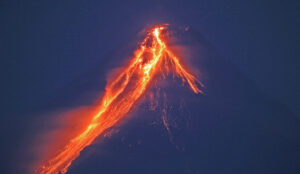
The ongoing unrest of Mayon Volcano may lead to lava flows and lava fountaining in the coming days, according to the Philippine Institute of Volcanology and Seismology (PHIVOLCS).
The country’s most active volcano was raised to Alert Level 3 from Alert Level 2 on Tuesday after the observation of a magmatic eruption of a summit lava dome.
PHIVOLCS said that this activity brings a heightened chance of lava flows and hazardous pyroclastic density currents (PDCs), which are fast-moving, superheated avalanches of volcanic gas, ash, and debris.
”We might expect after a while, once the discharge of new magma or lava at the crater of Mayon has somewhat stabilized, that we will already have lava flows,” Ma. Antonia “Mariton” V. Bornas, Chief of the Volcano Monitoring and Eruption Prediction Division at PHIVOLCS, said in an interview.
“It’s also possible to experience lava fountaining from Mayon Volcano.”
Ms. Bornas noted that the potential volcanic event is likely to be similar to the 2023 eruption, which involved an effusive eruption, or slow lava flow, that lasted for several months.
While the lava flow itself is slow and does not cause immediate hazards, it may still result in PDC events, she said.
”The lava flows are also prone to collapse, and the collapsing lava flows will produce pyroclastic density currents as well,” she said, noting that these may affect areas within the six-kilometer danger zone.
Although an effusive eruption is the likely scenario for Mayon, Ms. Bornas said there is still a small possibility of an explosive eruption due to the volcano’s long pre-eruptive period.
Ground deformation has been observed at the volcano since June 2024, she said.
If monitoring parameters continue to escalate, PHIVOLCS is likely to raise the status to Alert Level 4.
Ms. Bornas reminded the public to strictly avoid the six-kilometer Permanent Danger Zone (PDZ) to stay safe from hazards such as PDCs, rockfalls, and ballistic projectiles. She also warned of potential lahars, or volcanic mudflows, during periods of heavy rain, advising the public to avoid river channels as lahars can be scalding hot.
As of 12:00 a.m., Alert Level 3 remains in effect for Mayon. According to PHIVOLCS, 131 rockfall events and five PDCs were recorded over the recent monitoring period. A sulfur dioxide flux of 702 tons per day was also recorded, indicating that the volcano remains in a state of swelling and high unrest. A visible crater glow was also observed during the monitoring period.
Mayon is one of 22 active volcanoes in the Philippines and has erupted more than 50 times over the last four centuries. Its most destructive eruption occurred in February 1814, claiming the lives of about 1,200 people. The Philippines is located within the “Pacific Ring of Fire,” a belt characterized by a high concentration of active volcanoes and frequent, intense earthquakes.—Edg Adrian A. Eva