

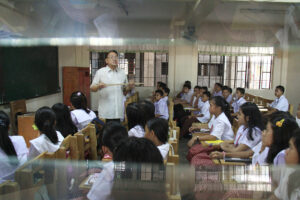
A MEASURE that will authorize local government units and civil society organizations (CSO) to undertake classroom construction projects should include safeguards against potential corruption, a senator said.
Senator Panfilo M. Lacson said the involvement of nongovernment organizations (NGO), particularly in bidding and monitoring classroom projects, may create “conflict of interest.”
“Probably (we can include a) caveat, that provided they will not monitor themselves,” he said during his interpellation of Senate Bill No. 1482, “Classroom-building Acceleration Program (CAP) Act,” on Wednesday evening.
“At the proper time maybe, we can use the proper language to clarify that particular issue. But I have no objection to allowing NGOs to be active partners in the school building program of the government.”
Citing Republic Act No. 12009, the “Government Procurement Act of 2024,” Mr. Lacson said NGOs’ role in the procurement process are limited to mere observers to avoid a conflict of interest.
“There goes the problem. If we involve CSOs in the construction of buildings, one way or another, directly or indirectly, and the definition of NGOs and CSOs are interchanged, we might have a Napoles situation. How do we resolve this issue?” he said.
Mr. Lacson was referring to Janet Lim Napoles, the so-called pork barrel queen, who is at the center of the scam that allowed lawmakers to fund small-scale projects in their districts that fell outside the national infrastructure program. This was voided by the Supreme Court in 2013 for being illegal.
The chamber was tackling Senate Bill No. 1482, in substitution of Senator Paolo Benigno Aquino IV’s Senate Bill No. 121, for second reading approval.
Mr. Aquino pushed for the passage of the measure to address the classroom shortage in the country.
“Previously, the Department of Public Works and Highways (DPWH) was the only one making classrooms, and that led to only 60 classrooms being finished for this year,” Mr. Aquino said in a statement.
He added that the Public Works department’s classroom output for the year was “unacceptable,” noting mismanagement in the classroom construction program.
The DPWH said earlier that it had only constructed about 60 classrooms this year out of its 1,700 classrooms.
The country currently has a backlog of 165,000 classrooms, which the Education department estimates would take 55 years to complete.
The measure is expected to help expedite the construction of classrooms. It also seeks to decentralize the construction of local classrooms by expanding the mandate beyond the DPWH.
“Let’s try that and then let’s monitor it. Every year, when we see what works, that’s what we’ll fund,” Mr. Aquino added.
A study by the Philippine Institute for Development Studies said that the country needs to build at least 7,000 classrooms annually to address the classroom backlog.
The Second Congressional Commission on Education (EDCOM II) has also urged Department of Education to factor in population growth, building deterioration, disaster vulnerabilities, and the capacity of private schools when mapping out long-term classroom needs. — Adrian H. Halili