
By Mhicole A. Moral, Special Features and Content Writer
The Philippines is set to enter 2026 with a measured outlook as economists and policy makers track signs of stable movement in key indicators. The ASEAN+3 Macroeconomic Research Office reported that the country’s domestic structure and access to varied export markets supported performance throughout 2025, even as trade tensions overseas created pressure across Asia. Gross domestic product for 2026 stands at 5.3%.
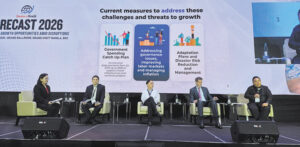
Macroeconomic prospects were among the discussions at the BusinessWorld Forecast 2026 forum held on Nov. 25 with the theme “Seizing New Growth Opportunities Amid Disruptions.” Government and private-sector panelists examined how the country can manage volatility while preparing for emerging challenges in the coming year.
Finance Assistant Secretary said the government expects both positive and negative outcomes as it adjusts spending plans and works to boost economic confidence.
“We were able to address issues with a long-staged process of increasing funds and projects. [We have] a well-developed consumption. [However,] we have seen lower investment funds, so there is a slightly lower level of investment. What is concerning is that this is happening,” he said.
Department of Finance Assistant Secretary Neil Adrian S. Cabiles
Mr. Cabiles added that the government is taking steps to strengthen investor confidence by improving project selection, public spending performance, and policy stability. To keep projects on track, the Department of Finance revised its cash spending plan and accelerated public spending.
“We have revised the government spending cash plan. We have accelerated this [spending] from June 4, 2025, up to 2026, concentrating more on specific infrastructure. We are making sure that these are really good projects and that there is proper implementation for them,” he explained.
Andrew Jeffries, country director of the Asian Development Bank (ADB), said the Philippines started the decade as one of Southeast Asia’s fastest-growing markets. However, momentum slowed following recent controversies in flood control projects that delayed public works. The resulting drop in government spending affected overall economic growth, since public investment plays a major role in creating jobs and supporting supply chains.
Asian Development Bank Country Director for the Philippines Andrew Jeffries
“[Gross domestic product] growth was dragged down as a result of public investment, which has a big multiplier effect on the economy, both in the short term and long term. It has significantly slowed. So, where are we now? There are still a lot of tailwinds in this economy,” he said.
Despite these setbacks, household consumption, which accounts for roughly 70% of gross domestic product, remains strong. Low unemployment and steady remittances help families manage rising costs.
Mr. Jeffries also said the financial sector remains stable. Nonperforming loans, for instance, dropped from 3.3% in 2024 to 3.1% in 2025. Banks maintain capital levels above the 10% benchmark set by regulators. The country’s credit rating outlook remains intact, and fiscal consolidation is progressing as planned.
Similarly, Eduardo V. Francisco, president of BDO Capital & Investment Corp. (BDO Capital), noted that while overall growth is weaker than previous years, it remains workable. He described the economy as “gloomy,” influenced by foreign capital leaving the market and questions about long-term economic confidence.
BDO Capital President Eduardo V. Francisco
“We see growth slowing, but it is manageable. At least, we are trying to adjust a bit because of seasonal differences. On the personnel side, I guess it is pretty depressing. With what is happening in the market, it is depressing for investors,” he shared.
Mr. Francisco explained that investors watch consumer spending closely because it shapes how the government responds with infrastructure and public investment. When households spend and companies invest, it creates pressure on the government to support activity with new projects.
“When people continue to invest and spend, the government will see that it needs to build infrastructure to support it,” he added.
Meanwhile, Nicholas Antonio T. Mapa, chief economist and markets strategist at Metropolitan Bank & Trust Co. (Metrobank), highlighted the need for stable prices as a foundation for economic growth. He said the Philippines remains highly dependent on household spending, and keeping prices in check is essential to sustaining the economy.
“Given that the Philippines is still heavily reliant on household consumption, price validity and keeping a check on price pressures will go a long way in ensuring that we can have at least a stable base for growth [moving forward]. So, once again, hopefully [the] government can double its efforts to keep prices stable on the supply side,” he explained.
He urged the government to strengthen efforts on the supply side to manage inflation. Proper price management, he noted, supports the Banko Sentral ng Pilipinas (BSP) toward appropriate monetary policy.
“If we do have price validity, this would give the central bank some room to provide support to the economy. And I think the BSP has done just that, implementing several rate cuts to try to support moderating growth momentum,” he added.
Metrobank Chief Economist and Markets Strategist Nicholas Antonio T. Mapa
Addressing tailwinds in economy
Fiscal multiplier, which economists refer to the additional economic activity, is viewed important as the government funds move through the economy.
Mr. Mapa explained that government projects support the fiscal multiplier as funds move through local businesses. Recent infrastructure spending, however, had limited impact because some projects were delayed or only partially executed.
“[A fiscal multiplier] has been sort of missing in the last few years, [allegedly] because these projects were never happening,” he said. “So, if we do figure this out, it will generate a fiscal multiplier, and then we can have more economic activity.”
Mr. Cabiles noted that the government is monitoring the multiplier effects of public projects and making strategic adjustments to ensure long-term benefits.
“Part of improving investment confidenceis the [oversight] that we have. We see that there has been some growth. We have improved more strategic measures in terms of this step, and the process of improving projects has also become more strategic, whether these projects have [significant] multiplier effects, and whether they are truly effective,” he added.
Consequently, Mr. Francisco emphasized that government spending could have a greater effect if funds are allocated more efficiently. He said accountability matters for market stability and expressed hope for stronger action from authorities.
“I want to see the government deliver that they are serious about addressing [corruption],” he emphasized.
Mr. Jeffries added that the government is adjusting its priorities across sectors while staying focused on long-term projects. Rules for public-private partnerships have been relaxed to encourage more investment from the private sector.
On the other hand, Mr. Francisco explained that local banks can finance long-term infrastructure projects with support from organizations like the International Finance Corp. and ADB, which have experience in guiding large privatizations.
“We have the liquidity and capacity,” Mr. Francisco said. “The challenge is getting more projects out into the economy.”
Labor concerns remain significant in the economy, according to Mr. Jeffries. While unemployment stays low, underemployment is high, hovering near 12%. Many of the jobs created are in the service sector and tend to be lower-skilled. Meanwhile, about a third of Filipino workers are employed in agriculture, which continues to face logistical difficulties and high transport costs.
The pandemic has also left lingering effects on the education system, which in turn affects workforce readiness.
“The pandemic left a scarred education system. There is a need for technical and vocational education, and reskilling will require businesses to take the lead because the training and skills that need to be developed [must meet the purpose of industry and workforce needs,” he explained.
The panelists added that climate risks, geopolitical tensions, and technological disruption all pose threats. Therefore, building a resilient economy requires integrating long-term planning and structural reforms.